
How to Play the Palworld Official Card Game
Bushiroad's Palworld card game, explained from the first Soul to the winning attack. Everything here is taken from the official Quick Manual and Comprehensive Rules, current for Dawn of Palpagos.
What You Need to Play
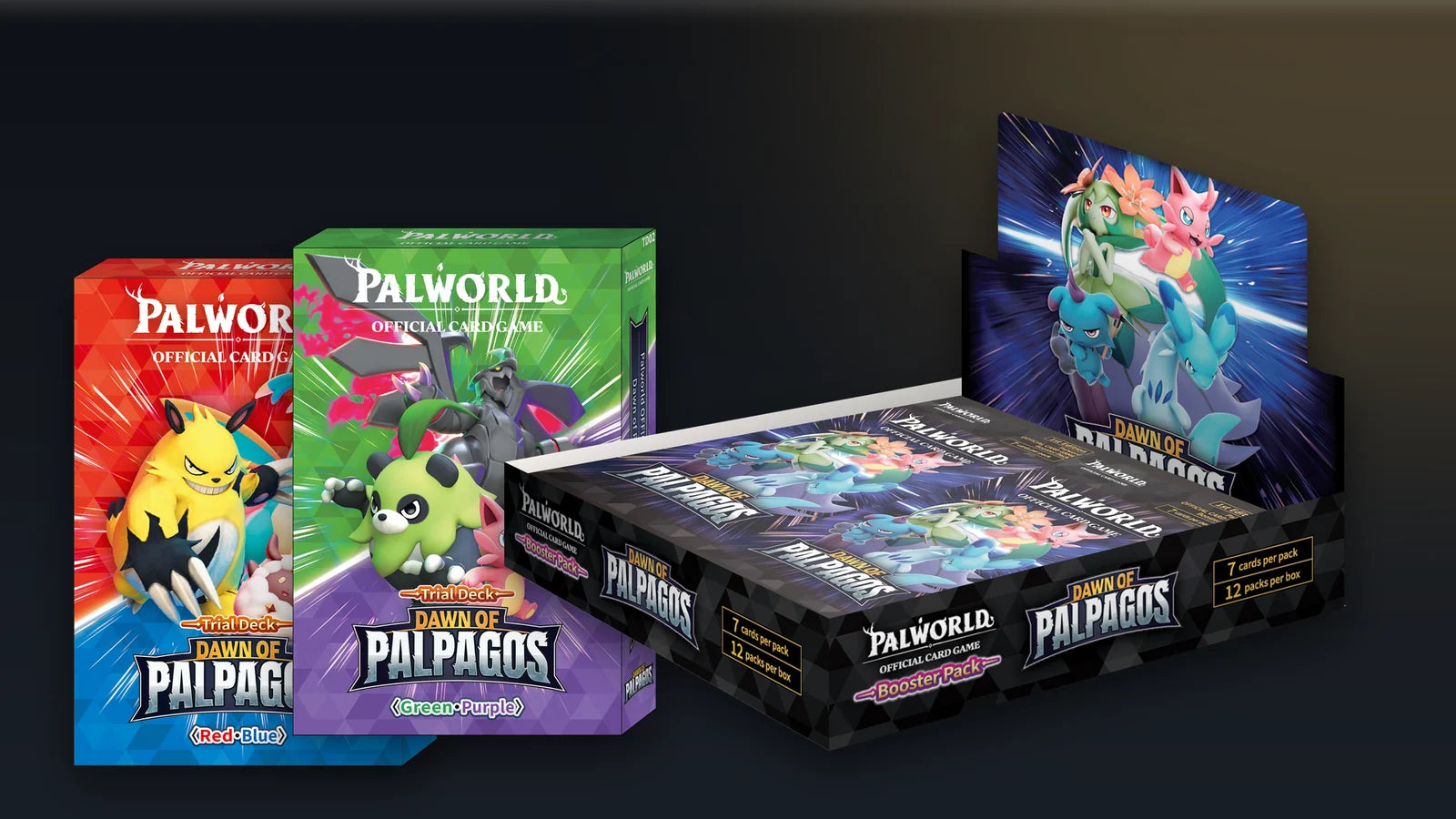
The Palworld Official Card Game is a two-player game from Bushiroad, the people behind Cardfight!! Vanguard and Weiss Schwarz, built on Pocketpair's Palworld. You lead a base of Pals, put some of them to work and send the rest to fight. It launched worldwide on 30 July 2026 with one booster set, Dawn of Palpagos, and two trial decks. Here is what goes on the table:
- A 50-card main deck: Pals, Gear, Structures and Events, in no more than two colours.
- A 10-card Soul Deck: identical Soul cards kept in a separate pile. Souls are how you pay for everything, and they never get used up.
- A life counter: you both start on 10. The trial decks include one, or use a dice.
- A material counter: some Structures produce Material and Ingredients. Also in the trial deck, or use any tokens.
- A playmat: optional, but the paper one in the trial deck labels every zone and has the turn order printed down the side. Worth using for your first few games.
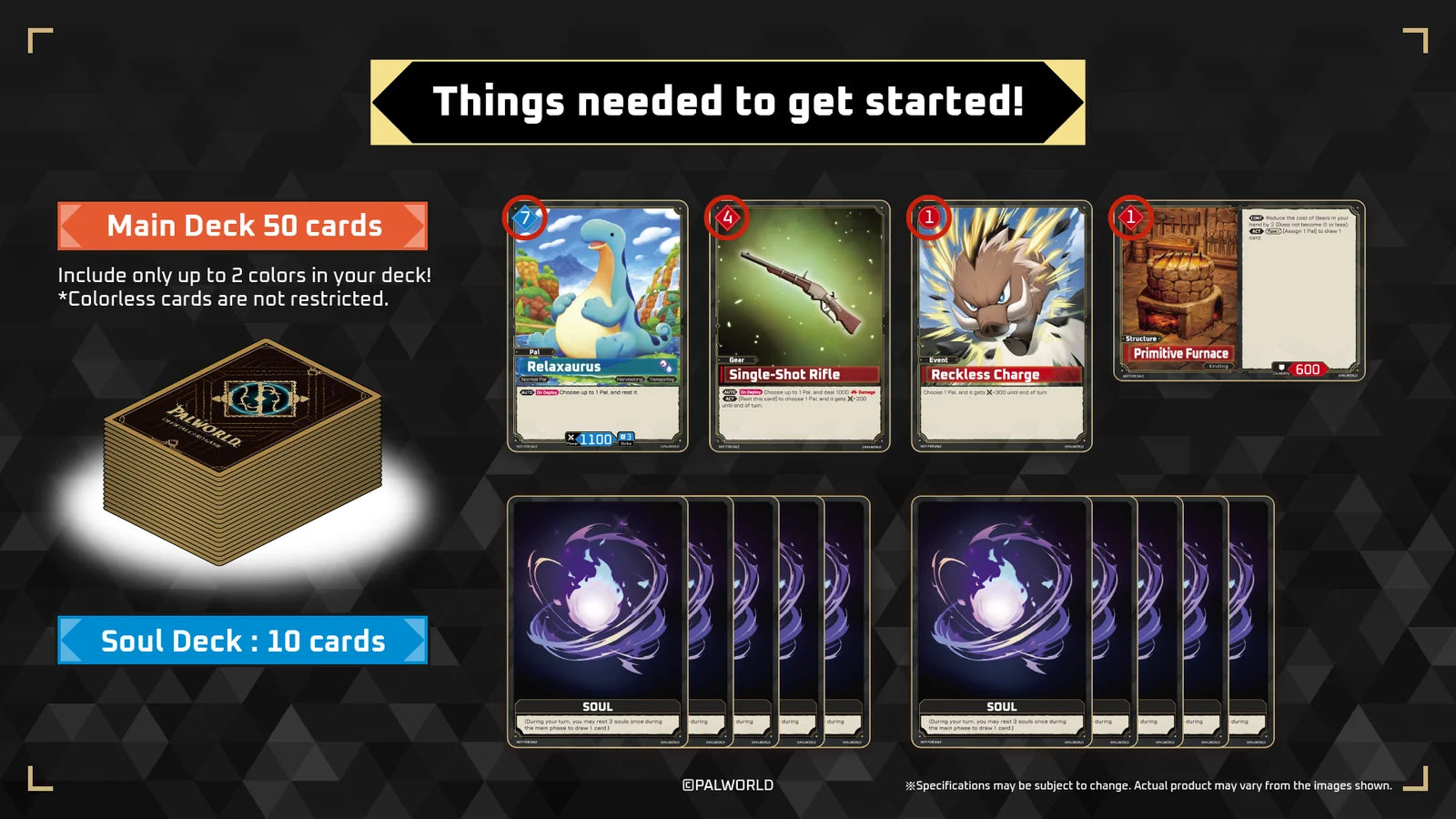
Main deck plus Soul Deck. Image: Bushiroad
💡 Where to start
Buy one Red-Blue or Green-Purple trial deck. Each is a complete, tournament-legal deck with the Souls, a playmat, both counters and a booster pack thrown in. Two friends with one deck each can be playing in ten minutes, and the two decks are built to play against each other.
How to Win
Both players start on 10 life. Your Pals attack the other player directly, and each hit that lands takes life off them. Get your opponent to zero and you win.
🏆 Win Condition
Reduce your opponent's life to 0. Every Pal has a Strike value, and that is how much life a successful attack on the player takes. A Strike 4 Pal that connects takes them from 10 to 6.
There is a twist, and it is the best idea in the game. When a player takes damage they do a damage check: they flip cards off the top of their deck into the graveyard, one at a time, up to the amount of damage. If any flipped card carries the Lucky icon, the whole hit is cancelled and they lose no life. So every Lucky Pal in your deck is also a shield, which is why you are limited to eight of them.
💀 Two ways to lose
Life at 0 is the usual one. But every damage check also burns cards off your deck, and a player whose deck hits zero cards loses immediately. Fifty cards sounds like plenty. After a few big hits and a lot of draw effects it is not.
The Playmat
Six zones, and the turn order printed down the left so you never have to remember it. Learn what lives where and the rest of the rules fall into place.
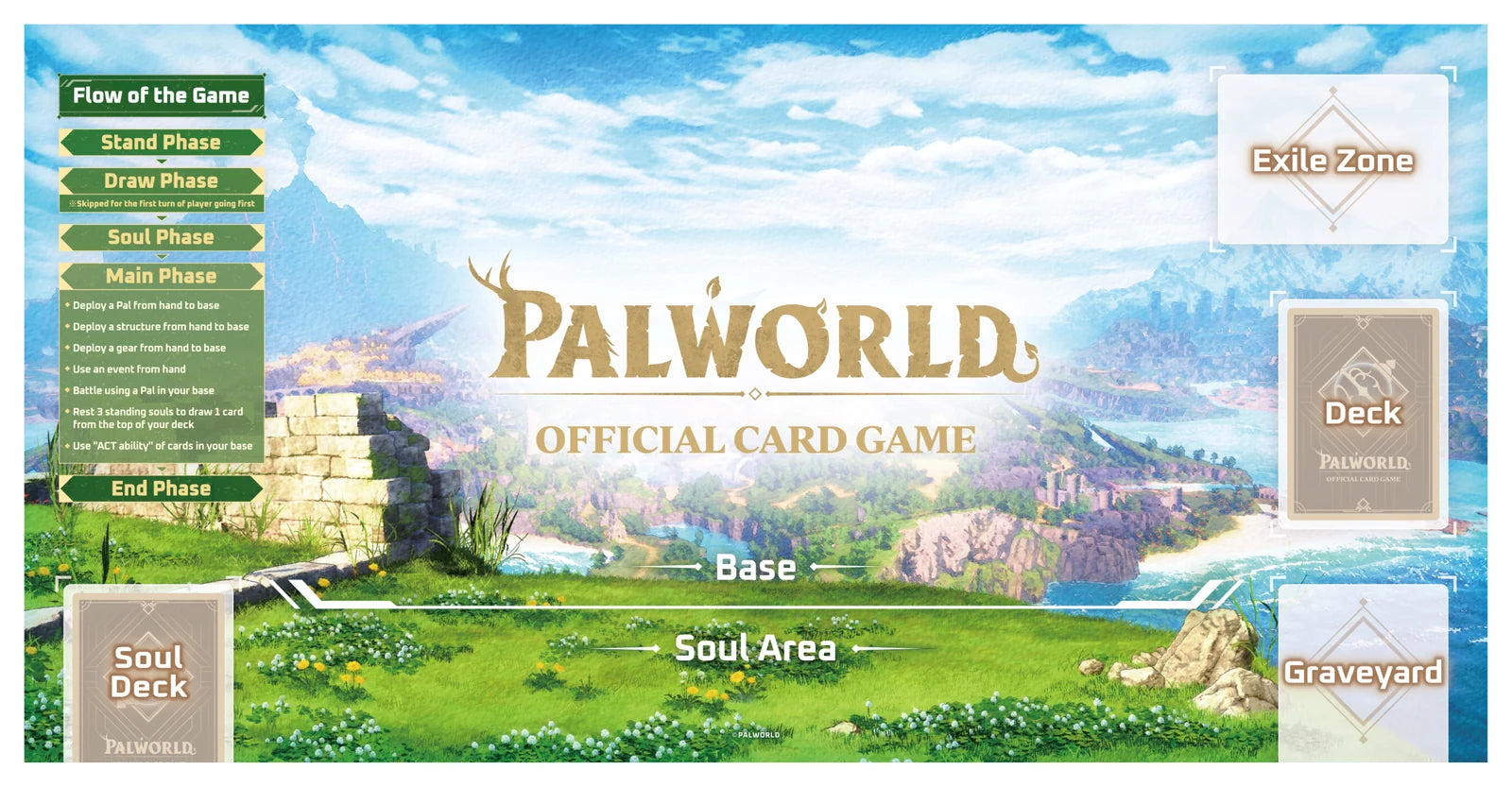
The official playmat. Image: Bushiroad
Base
The big central area. Your Pals, Structures and Gear all sit here once deployed, and this is where battles happen. You can have up to five Pals in your base at once (a sixth means one goes to the graveyard) but there is no limit on Structures or Gear.
Soul Area and Soul Deck
Your Soul Deck is the pile of ten Souls you have not used yet. Two of them move into the Soul Area every turn, and the Souls in the Soul Area are what you rest to pay for cards. More on this in a moment, because it is the engine of the whole game.
Deck and Graveyard
Your main deck is your draw pile and, thanks to the damage check, your buffer against losing. The graveyard is the face-up discard pile where destroyed Pals, used Events and damage-check cards end up.
Exile Zone
A holding area for cards that certain effects remove from the game. You will rarely touch it in your first few games.
Reading Your Cards
Every card has a cost in the top corner, a card type on the name bar and rules text at the bottom. Pals carry three more numbers that decide every fight.
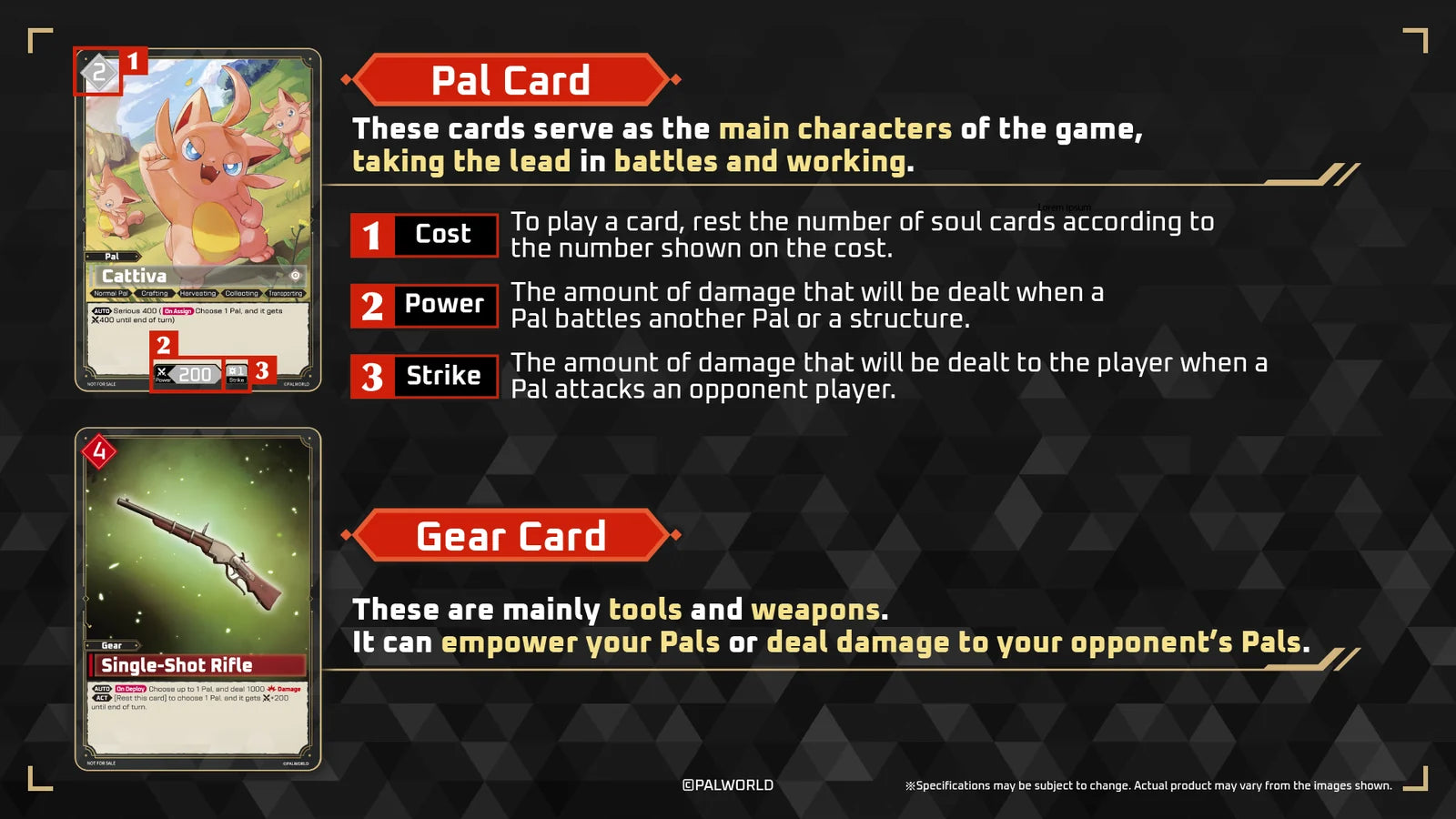
Cost, Power and Strike on a Pal card. Image: Bushiroad
- Cost: the number of Souls you rest to play the card. The colour behind the number is the card's colour (red, blue, green or purple; some cards are colourless).
- Power: the damage a Pal deals to another Pal or a Structure, and how much it can take before it is destroyed. On a Structure this number is called Durability.
- Strike: the damage a Pal deals to the player. Usually much smaller than Power. A 1700 Power dragon might only have Strike 4.
- Lucky icon: the gold star in the top right of a Lucky Pal. Referenced during damage checks. Lucky Pals count as Pals in every other way.
- Element (Fire, Water, Grass, Electric, Ground, Ice, Dark, Dragon, Neutral) and Work Suitability (Kindling, Watering, Harvesting and so on): small icons and tags under the name. Neither has a built-in rules effect like weakness or resistance. They matter only when a card's text names them.
- Card text: the abilities. The bracketed labels at the start of each line tell you when it happens, explained below.
The Five Card Types
Pal
The creatures. Deploy them to your base to fight, block and work. Only Pals attack, and only Pals have Strike.
Gear
Tools and weapons deployed to your base. They boost your Pals or deal damage to the opponent's, usually by resting the Gear to use it.
Structure
Buildings for your base. Assign a Pal to one and something happens: draw a card, gain Material, buff a Pal. They have Durability instead of Power and can be attacked.
Event
One-shot effects. Pay the cost, do the thing, graveyard. Events with the Quick icon can be played on your opponent's turn.
Soul
Your resource. Ten identical cards in their own deck, never shuffled into the main deck. Rest them to pay costs; rest three to draw.
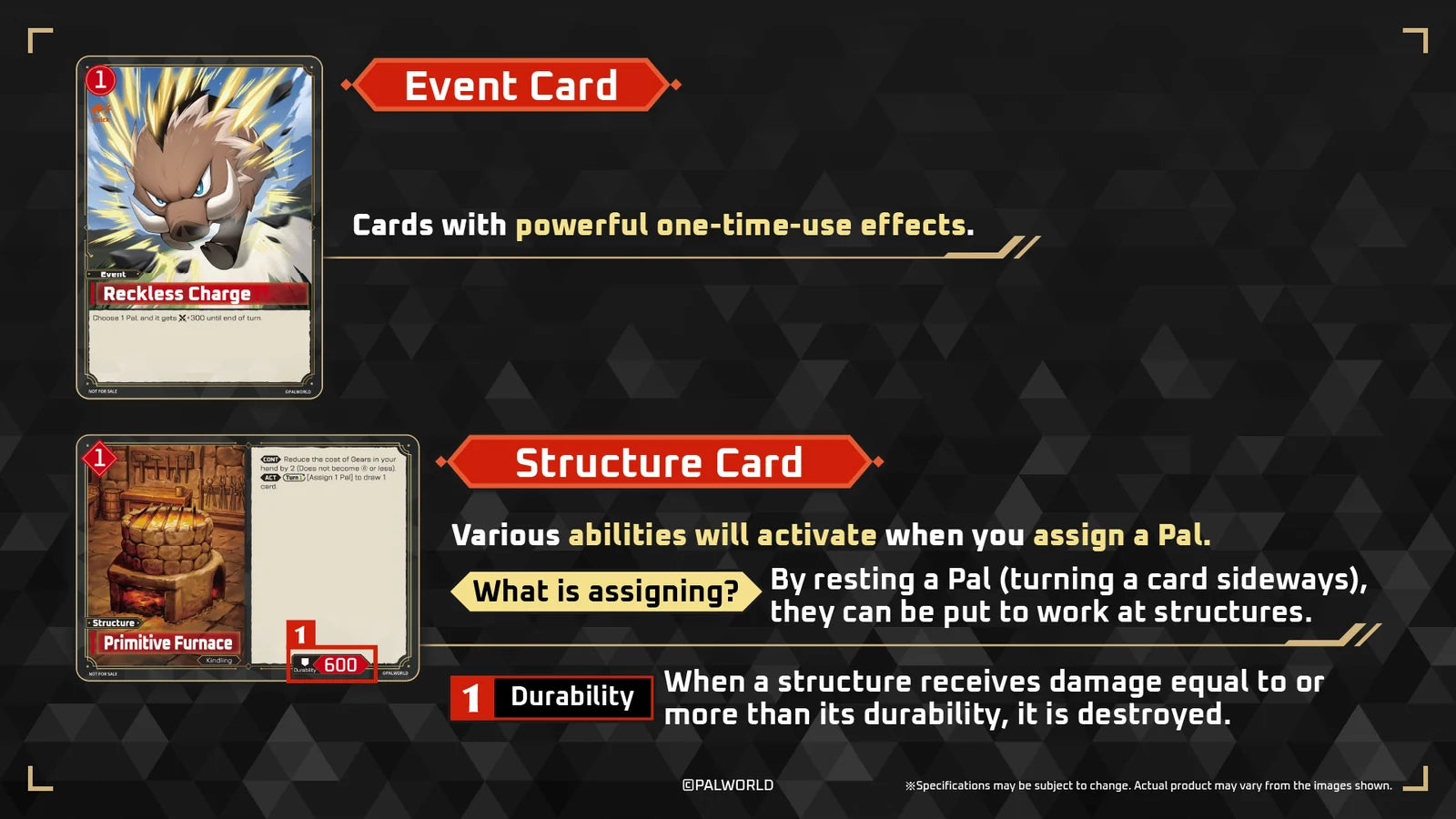
Events are one-time effects; Structures have Durability and take assigned Pals. Image: Bushiroad
Timing Labels
The labels at the start of a line of card text tell you what kind of ability it is and when it fires:
| Label | What It Means |
|---|---|
| [ACT] | An activated ability. You choose to use it in your Main Phase by paying whatever is in the square brackets: Souls, resting the card, discarding, assigning a Pal. |
| [AUTO] | An automatic ability. It fires by itself when its condition happens, no cost unless stated. |
| [CONT] | A continuous ability. Always on while the card is in your base. Keywords like Assault and Taunt are continuous. |
| [On Deploy] | Fires when the card enters your base. The most common trigger in the set. |
| [On Attack] / [On Assign] | Fires when this Pal attacks, or when it is assigned to a Structure. |
| [1/Turn] | The ability can only be used once each turn. |
| [Quick] | Can be played in the Quick Step of your opponent's attack, so it is your answer to being hit. |
ℹ️ Card text wins
If a card's text contradicts the rules, the card is right. Bushiroad writes this into the first page of the Comprehensive Rules and it comes up more than you would think.
Souls and Cost
There is no energy to attach and no land to draw. Your resource is the Soul Deck, and it arrives on a fixed schedule: two Souls move from the Soul Deck to the Soul Area at the start of every one of your turns. Turn one you have two (or three, if you went second), turn two you have four, and after five turns all ten are out.
To play a card you rest (turn sideways) standing Souls equal to its cost. A cost 3 Structure rests three Souls. A cost 8 Pal like Jormuntide Ignis needs eight Souls in the area, which means turn four at the earliest. Rested Souls are not spent; they all stand up again in your next Stand Phase, so your budget refills every turn and only ever grows.
- Cost is per card, once. There is no upkeep. A Pal in your base costs nothing to keep there.
- Colour does not gate anything. Souls are colourless. Any Soul pays for any card. Colour only matters when you build the deck.
- Souls also draw cards. Once per turn in your Main Phase you can rest three Souls to draw one. Late in the game, when you have ten Souls and nothing to spend them on, this is where the spare ones go.
💡 Count your curve
Because Souls arrive two a turn, the maths is easy: a cost 4 card is a turn-two play, cost 6 is turn three, cost 8 is turn four. A deck full of sevens and eights does nothing for the first three turns while a deck of twos and threes is already swinging. Trial decks are built to curve out; copy that shape when you build your own.
Setting Up the Game
Under a minute once you have done it once.
Shuffle and place
Shuffle your main deck and put it in the deck zone. Put your ten Souls in the Soul Deck zone. Set your life counter to 10.
Decide who goes first
Rock-paper-scissors, a dice, whatever you like. Going first means no draw on your first turn; going second means you start with a head start on Souls.
Second player gets a Soul
The player going second moves one Soul from their Soul Deck into their Soul Area, standing. That is the game's compensation for moving second, and it means they hit three Souls on turn one and five on turn two.
Draw five
Both players draw a hand of five cards.
Mulligan if you want
Starting with the first player, each of you may once put your whole hand back, shuffle, and draw five new cards. All or nothing, and you keep the second hand whatever it is.
Playing a Turn
Five phases, always in this order. There is no separate battle phase: attacking happens in the Main Phase, mixed in with everything else, in whatever order you like.
Stand Phase
Stand everything in your base and your Soul Area. Every Pal that attacked or worked last turn is ready again, and every Soul you spent is back.
Draw Phase
Draw one card. The player who went first skips this on their very first turn.
Soul Phase
Move two Souls from your Soul Deck into your Soul Area, standing. If only one is left, move that one.
Main Phase
Do any of these, as many times as you can afford, in any order: deploy a Pal, Structure or Gear by resting Souls; play an Event; use an [ACT] ability; assign a Pal to a Structure; attack with a standing Pal; and, once per turn, rest three Souls to draw a card. A Pal you deployed this turn can attack straight away.
End Phase
All damage on every Pal and Structure, yours and theirs, resets to zero, and "until end of turn" effects wear off. Then it is your opponent's turn.
ℹ️ Damage does not carry over
This is the rule new players miss. A Pal that took 900 damage from a 1700 Power attacker is not "wounded" next turn; it is back to full in the End Phase. If you want a Pal gone, you have to deal its full Power in one turn, whether from one attack, two attacks, or an attack plus a Gear.
Battle in Depth
To attack, rest a standing Pal in your base and pick a target. Legal targets are the opposing player, one of their Structures, or one of their rested Pals. A standing Pal cannot normally be attacked, which is why resting a Pal to work or block is a real cost: it is a target until your next Stand Phase.
Pal against Pal
Both Pals deal damage equal to their Power to each other at the same time. Any Pal that has taken damage equal to or more than its Power goes to the graveyard. Attacking into something bigger than you is usually a trade you lose on your own.
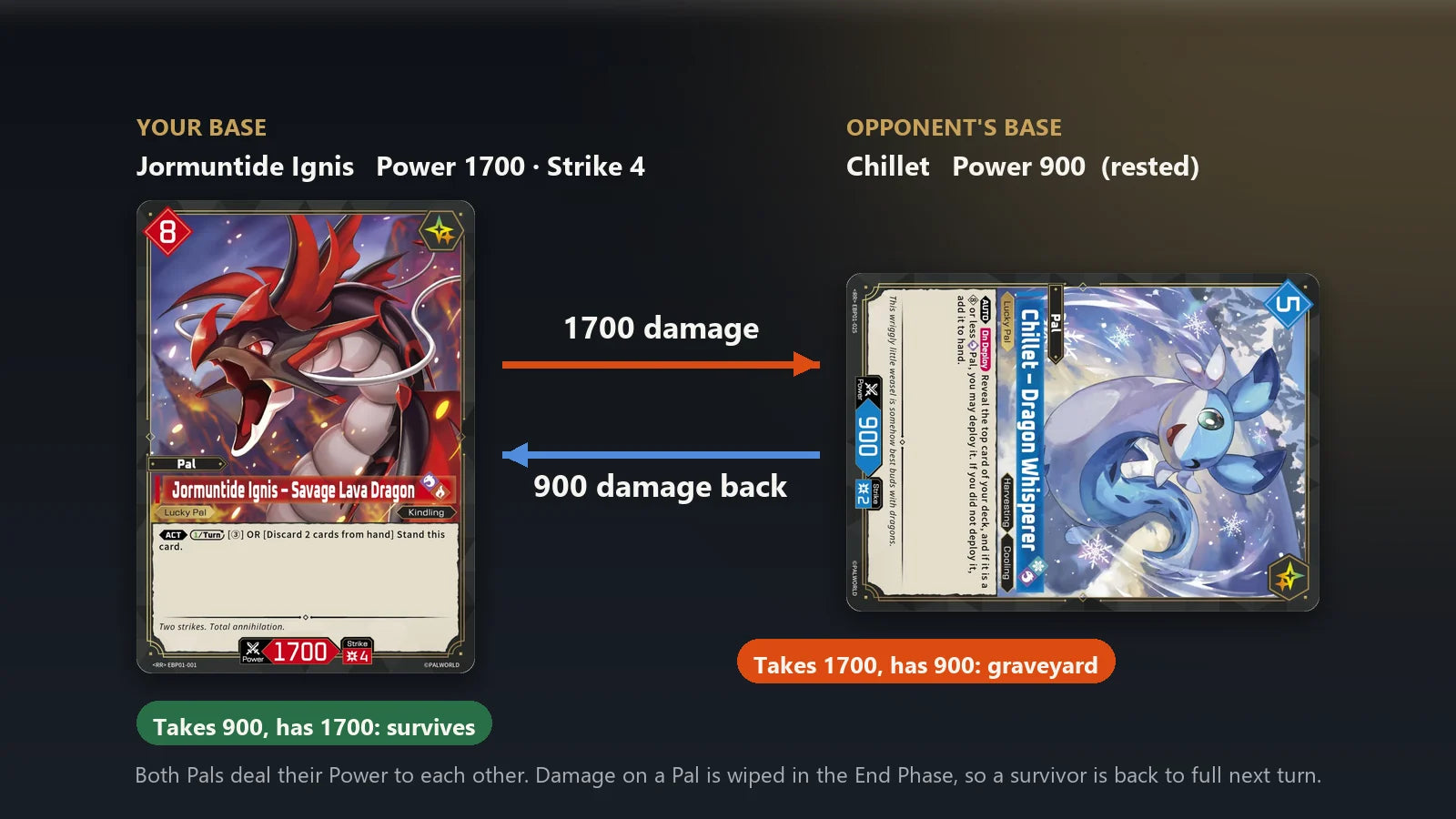
Jormuntide Ignis (1700) into a rested Chillet (900). Both deal their Power; only Chillet goes down.
Pal against Structure
Your Pal deals its Power to the Structure's Durability. The Structure deals nothing back. If the damage equals or beats the Durability the Structure is destroyed, and any Pal assigned to it is simply standing around again.
Pal against the player
This is where games are won. Your Pal deals its Strike to the player, who then runs the damage check:
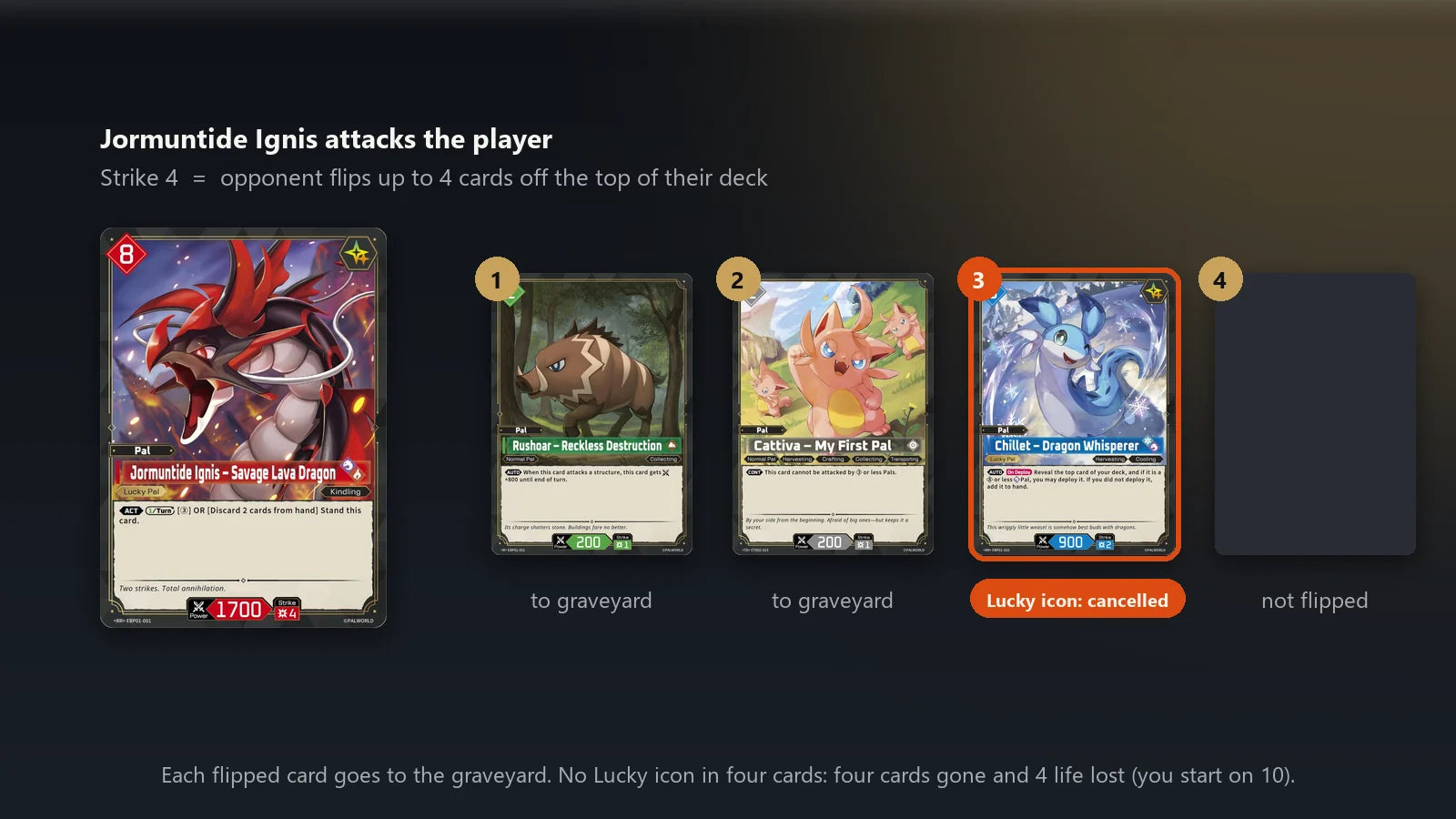
Strike 4: flip up to four. A Lucky icon on the third card stops the check and cancels the damage.
Flip the top card into the graveyard
One at a time, face up. Each one is gone for good.
Lucky icon? Stop.
If the card you just flipped has the Lucky icon, the damage becomes zero. No life lost, no more cards flipped. It is all or nothing: a Lucky on the fourth card of a Strike 4 hit still cancels the whole thing.
No Lucky? Lose the life.
Once you have flipped cards equal to the damage (or your deck runs out), lose that much life. Strike 4 with no Lucky in the first four cards means four cards gone and four life gone.
Blocking
When you are attacked, before damage, you may rest one of your standing Pals to block. It becomes the target instead of whatever was attacked, and the battle plays out as Pal against Pal. This is the main reason to leave a Pal standing at the end of your turn: a standing Pal is a wall, a rested Pal is a target. Attackers with Stealth cannot be blocked.
The Quick Step
After blocks are declared, the defending player (and only the defender) may play Events and abilities marked [Quick]. A Quick Event that pumps your blocker's Power by 300 can turn a losing block into a winning one, and the keyword Interrupt lets you discard the card and pay a Soul to cancel the attack outright.
Keywords you will meet in Dawn of Palpagos
| Keyword | What It Does |
|---|---|
| Assault | This Pal may attack standing Pals as well as rested ones. Nothing on the other side is safe. |
| Taunt | If this card can be attacked, the opponent has to attack it. A rested Taunt Pal protects everything else. |
| Stealth | This Pal's attacks cannot be blocked. |
| Brave (number) | When this Pal attacks, it gains that much Power until end of turn. |
| Serious (number) | When this Pal is assigned to a Structure, choose a Pal and give it that much Power until end of turn. |
| Retaliate | If this Pal dies in a battle, the Pal it fought dies too. |
| Breakthrough | If this Pal destroys the Pal it attacked, its Strike hits the player as well. |
| Vigilance | Stands itself at the end of your turn, so it can attack and still block. |
| Interrupt | A Quick ability: pay one Soul and discard this card (or discard it plus another card) to cancel an attack. |
| Nocturnal | +300 Power while it is "night", a state some cards switch on. |
Work, Structures and Materials
The other half of Palworld is putting Pals to work, and the card game keeps it. A Structure card sits in your base and does nothing on its own. Most of its abilities carry the cost [Assign 1 Pal]: rest one of your standing Pals, and it is now assigned to that Structure until it stands again. The Structure's effect fires: draw a card, gain three Material, give a Pal +400 Power.
- Assigning rests the Pal. That Pal is not attacking this turn, cannot block, and can be attacked. Work has a price.
- Work Suitability tags (Kindling, Watering, Harvesting, Crafting and the rest) only matter when a Structure's text asks for one. A furnace that wants a Kindling Pal will not take a Watering one. Otherwise any Pal can be assigned anywhere.
- Material and Ingredient are the two resources Structures produce. They are just counters; you cannot go below zero, both players can see them, and other abilities spend them with the word "Consume".
- Structures can be attacked, and they do not fight back. If your engine is a single Structure, expect it to be hit.
💡 Cheap Pals are workers
A cost 2 Pal with 200 Power will lose every fight it is in. Its job is to be assigned to your Structure every turn so the big Pals can stay standing. The trial decks are built exactly this way, with a handful of small Pals whose only purpose is to keep the furnace lit.
Deck Building
Four rules, all printed on the official Quick Manual:
| Rule | Limit |
|---|---|
| Main deck size | Exactly 50 cards. |
| Colours | Up to two colours. Colourless cards go in any deck and do not count. |
| Copies | Up to 4 cards with the same name. |
| Lucky icons | Up to 8 cards with the Lucky icon. |
| Soul Deck | 10 Soul cards, kept separate. |
The Lucky limit is the interesting one. Lucky Pals are your best cards and your only defence in a damage check, so eight is the number every deck runs. The colour rule is why the trial decks are Red-Blue and Green-Purple: each pair is a ready-made legal combination, and Dawn of Palpagos splits its 100 base cards almost evenly across the four colours.
The colours lean in different directions in the first set. Red is Fire Pals, Gear that deals damage directly and Structures that make Material. Blue is Water and Ice, and nearly every card-draw effect in the set. Green is Grass and Ground, Ingredients, and Taunt Pals that stand in front of everything else. Purple is Dark Pals, the night mechanic, the graveyard, and effects that butcher your own Pals for value. None of that is a rule; it is just where Bushiroad put the cards.
ℹ️ One note on sources
The two-colour limit is printed on the official Quick Manual and the trial decks are built to it, but the Comprehensive Rules (version 1.00) do not restate it in the deck-construction section. Play to the Quick Manual: two colours.
Glossary
The words that come up again and again on cards and in the rules:
| Term | What It Means |
|---|---|
| Stand / Rest | Upright / sideways. Standing cards are ready; rested cards have been used (attacked, worked, blocked or paid) and stand again in your next Stand Phase. |
| Deploy | Play a Pal, Structure or Gear into a base. "On Deploy" abilities fire when it happens. |
| Assign | Rest a standing Pal to put it to work at a Structure. |
| Soul | Your resource card. Rest them to pay costs; they stand every turn and are never lost. |
| Damage check | What the defending player does when hit: flip cards from the deck until a Lucky icon appears or the damage is matched. |
| Lucky icon / Lucky Pal | The gold star on some Pals. Cancels a damage check when flipped. Maximum eight per deck. |
| Power / Durability | Damage dealt to other cards and the amount it takes to destroy this one. Structures have Durability and deal no damage. |
| Strike | Damage a Pal deals to a player. |
| Block | Rest a standing Pal to take an attack in place of the original target. |
| Quick Step | The moment after blocks when the defender may play [Quick] cards and abilities. |
| Material / Ingredient | Counters produced mainly by Structures and spent by "Consume" costs. |
| Butcher | Send one of your own Pals to the graveyard as a cost. Yes, really. |
| Exile | Remove a card from the game into the Exile Zone. |
| Night | A game state some cards turn on. Nocturnal Pals get +300 Power while it lasts. |
Top Tips for New Players
Leave one Pal standing
Attacking with everything feels good until your opponent untaps, sees five rested Pals and picks them off. A standing Pal at the end of your turn is a blocker, and it cannot be attacked itself. Usually keep one back.
Hit the player, not the Pals
Damage on Pals vanishes at the end of the turn. Damage on the player does not. Unless you can kill a Pal outright this turn, your Strike is better spent on the life total and the deck.
Run all eight Lucky Pals
Eight Lucky cards in fifty means roughly one in six flips cancels a hit. It is your only passive defence in the game. There is no reason to run fewer.
Spend every Soul
Souls refill every turn, so an unused Soul is wasted. If you have three spare and nothing to play, rest them and draw. Late game, with ten Souls out, that draw is free.
Watch both decks
Every damage check and every Soul draw thins a deck. In a long game the player who runs out of cards loses on the spot, which turns a Strike 4 attack in the last turns into a threat to end the game even through a full life total.
Frequently Asked Questions
Ready to Build a Base?
Trial decks, booster boxes and every Dawn of Palpagos single, in stock in the UK.
Shop Palworld TCGLooking for a single card? Every Dawn of Palpagos single is listed with its full stat line, from commons to the Super Special Parallels.
More beginner guides are on our how to play hub, and delivery, condition and returns questions are answered in the FAQ. Rules in this guide follow Bushiroad's official Quick Manual and Comprehensive Rules v1.00 (30 July 2026).